


Cookware 3 min read
Check cookware for an induction hob

In this guide

An induction-compatible label is a starting point, not the entire fit check. Compare the cookware's stated compatibility with your hob's requirements, then look at the base size and the way you use the pan.
Begin with the two manufacturers
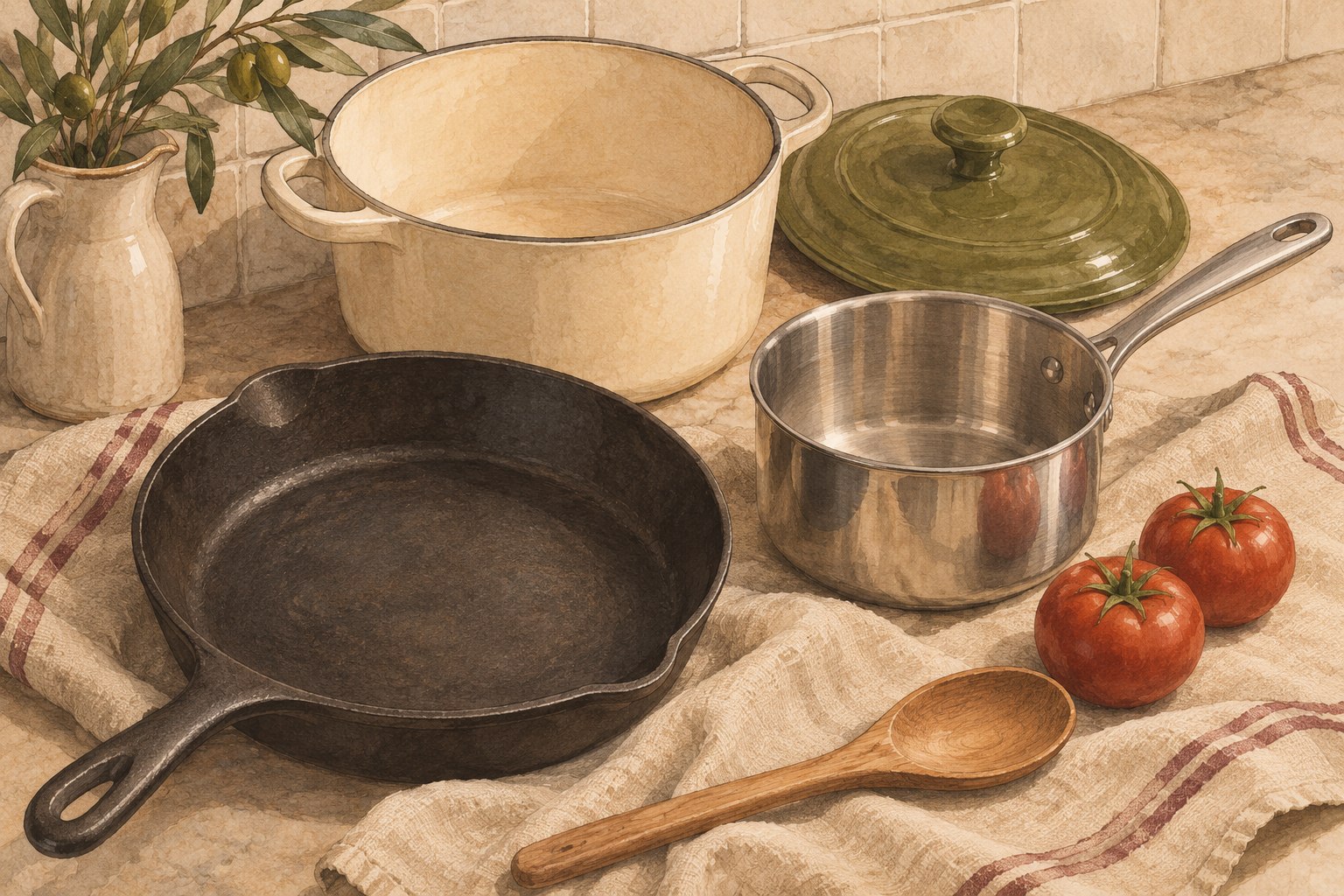
Read the hob manual for accepted pan sizes, placement and surface care. Then check the exact cookware model rather than relying on a material description copied from another pan. A collection can contain different constructions, and an old product name may cover several variants. The Lodge skillet, Lodge enamel Dutch oven and Tramontina stainless reference each explicitly list induction compatibility. That is more useful evidence than judging a photograph or assuming every pan from a brand has an identical base. Keep the model information with your shortlist.
Measure the part that meets the hob
The pan's top diameter includes its sides and may be wider than the base in contact with the cooking surface. Check the manufacturer's drawing where one is available, and compare it with the hob's specified range. Look at nearby zones as well; a pan can be individually suitable while preventing another vessel from sitting comfortably beside it. Include handles, lid knobs and the position of the controls in the layout. A paper outline is a simple way to compare working space before moving a heavy pan onto the surface.
Think about the everyday movement
Choose a setup that lets you lift and place cookware deliberately. A heavy vessel, a long handle and a busy counter can make repositioning awkward even when the appliance recognizes the pan. Follow the hob's surface-care directions rather than using cookware as a sliding storage item. Keep the base and surrounding work area ready for use, and leave a suitable resting place nearby. If several people cook in the kitchen, agree where hot cookware goes so that nobody has to infer the status of a pan from its appearance.
Replace gaps rather than an entire collection
List the pans that already have a clear, documented match for your hob. Identify the cooking job still missing, such as a wider frying surface or a covered pot, and shop for that job first. Avoid discarding a useful vessel solely because another model looks more coordinated. Check new cookware with a familiar recipe and the hob manual's recommended approach, keeping notes about the settings that work for your setup. Compatibility does not promise that every vessel responds identically, so allow room to learn the pairing rather than expecting a material label to supply a universal heat setting.
Tools to consider
Its manufacturer explicitly includes induction among compatible cooktops.
Consider before buying: Compare its actual base and footprint with your hob's requirements.
An induction-compatible covered-pot option.
Consider before buying: Check the weight, base placement and available working space.
A few practical questions
Does one compatible pan prove the whole set is compatible?
No. Check each exact model and construction, particularly when a cupboard contains pieces bought at different times.
Put it to work
Creamy tomato & spinach orzo · Lemony white bean skillet · Roasted carrot & ginger soup
Product information & sources
Recommendations are based on published product specifications and practical fit for the task. Check the exact model, seller, dimensions and care instructions before ordering.
Pinterest image
Keep this guide close for your next kitchen project.
